
The Essential Guide to K-1 Fiancé Visas
What is a K-1 fiancé visa
A K-1 visa allows a U.S. citizen to bring a fiancé into the U.S. for the purpose of getting married. The marriage does not have to take place immediately upon arrival, but the fiancé is required to marry the U.S. citizen within 90 days of her arrival in the United States. The spouse can apply for a green card while living in the United States. The K-1 visa is generally the fastest legal way to bring a fiancé into the U.S. for the purpose of getting married.
Eligibility
The intended spouse must be a U.S. citizen. A lawful permanent resident (green card holder) cannot sponsor a fiancé to come to the United States for the purpose of getting married.
The U.S. citizen and the fiancé must be eligible to get married. Both partners must be currently unmarried and be able to provide documentation proving that any previous marriages were terminated by divorce, death, or annulment. Same-sex partners are eligible for K-1 visas, even if the laws of the fiancé’s home country do not allow same-sex marriages.
The U.S. citizen and the fiancé must have met in person at least once and be able to provide evidence of the meeting. The meeting must have taken place in the last two years. A waiver can be granted if meeting in person would cause extreme hardship or violate religious and cultural practices.
The couple must intend to get married within 90 days of the fiancé arriving in the United States based on K-1 visa.
The household of the U.S. citizen must have certain amount of income. The income cannot be below the Federal Poverty Guidelines. If the income is below the guidelines, the U.S. citizen must get a co-sponsor.
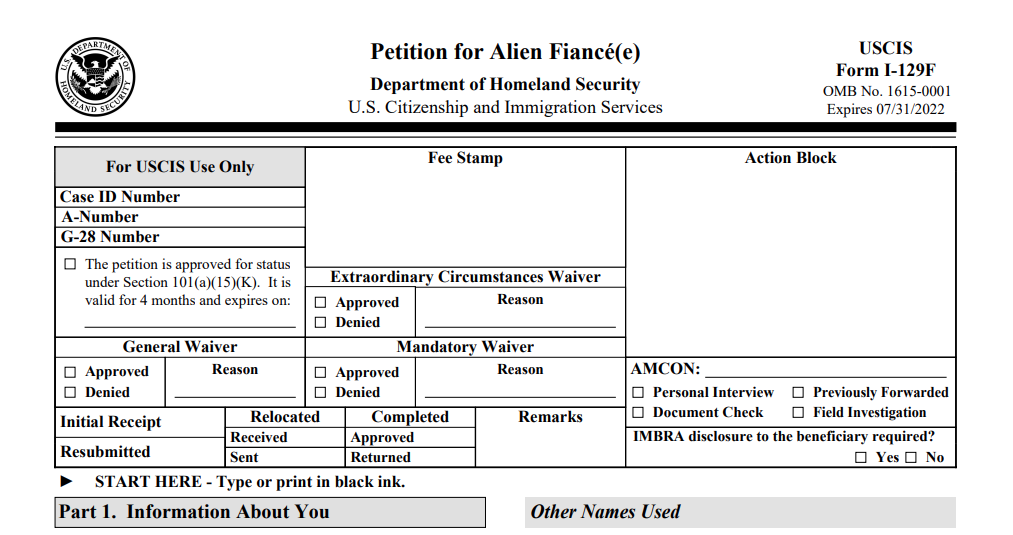
The first step in getting a K-1 visa for a fiancé is filing Form I-129F, Petition for Alien Fiancé. The petition is filed by a U.S. citizen to establish a qualifying relationship with the foreign fiancé. The couple must also prove that the relationship is legitimate. The couple must present evidence showing that the relationship is real and that the upcoming marriage is not going to be a sham marriage. The evidence that should be submitted varies for each couple and we provide detailed instructions.
Step 1. Form I-129F
The petition is filed with USCIS and starts the process that must be completed for the U.S. government to issue a K-1 visa to the foreign fiancé. The petition must be supported with evidence, including evidence of a legitimate relationship, proof of citizenship, proof of an in-person meeting, and other evidence.
It is vital to correctly complete the form and submit appropriate evidence supporting the petition. Any mistakes can trigger a Request for Evidence or a Notice of Intent to Deny, which can significantly delay your petition. Once the correctly completed petition is submitted, the USCIS will mail a receipt notice to confirm the receipt of your petition. The receipt letter is known as Form I-797C, Notice of Action. The letter generally arrives 2 to 3 weeks after the filing. USCIS also sends an approval notice once the petition is approved.
Step 2. DS-160
Step 3. Interview & Approval
FAQ
What income is required for K-1 fiancé Visa?
What happens if the couple gets married before the K-1 visa is issued?
Can a fiancé travel to the U.S. for business or pleasure while K-1 fiancé visa is pending for her?
How K-1 visas are different from regular immigrant visas?
Are the children of the K-1 beneficiary required to travel to the United States at the same time as the parent?
What are some of the reasons that K-1 visa applications are denied?
Can the beneficiary work in the United States?
Yes, the beneficiary can apply for work authorization as soon as she enters the country.